PROVIDING NHS SERVICES
NHS Meningitis B Vaccination
Heading off to Uni or College this year? If you’re finishing Year 13, you can get free Meningitis B Vaccination with us, to help protect against serious illness.

Jump To…
Why get vaccinated?
Before heading off to college, university, or starting a new job, make sure your health is protected. Meningitis is a severe infection caused by various bacteria and viruses that can lead to critical, life-threatening illness. Young adults are particularly vulnerable, especially when mixing with large groups of new people for the first time in halls or workplaces.
Getting vaccinated is the most effective way to safeguard your health. To achieve full, long-lasting protection, a complete course of two doses, spaced at least one month apart, is required.
Who can have the NHS Men B Vaccination?
We can provide a free NHS Meningitis B Vaccination course from any of our pharmacies for:
- young adults in the school year 13 age group (born between 1 September 2007 and 31 August 2008)
- young people born on or after 21st July 2001 and starting as undergraduates at university for the first time in Autumn 2026
- young people born on or after 21st July 2001 living in further education accommodation or halls of residence for the first time in Autumn 2026
How to get your Men B Vaccination
Book Today
Find us & book through the NHS website. If you can’t book a vaccination online, just give us a call or pop in!
Bookings open on 13th July 2026, with appointments available from 20th July 2026.
You can also call us to arrange an appointment…
Appointments are available from 20th July 2026. From this point, we’ll also accept patients who walk-in, subject to vaccinator availability.
Signs & Symptoms of Meningitis
Meningitis and septicaemia are rare but severe diseases that can kill or leave people with life changing disabilities and health problems. The vaccine protects against most strains of MenB bacteria but there are other causes of meningitis and septicaemia so you should still be aware of the signs and symptoms and should seek urgent medical advice if you or someone else has these symptoms.
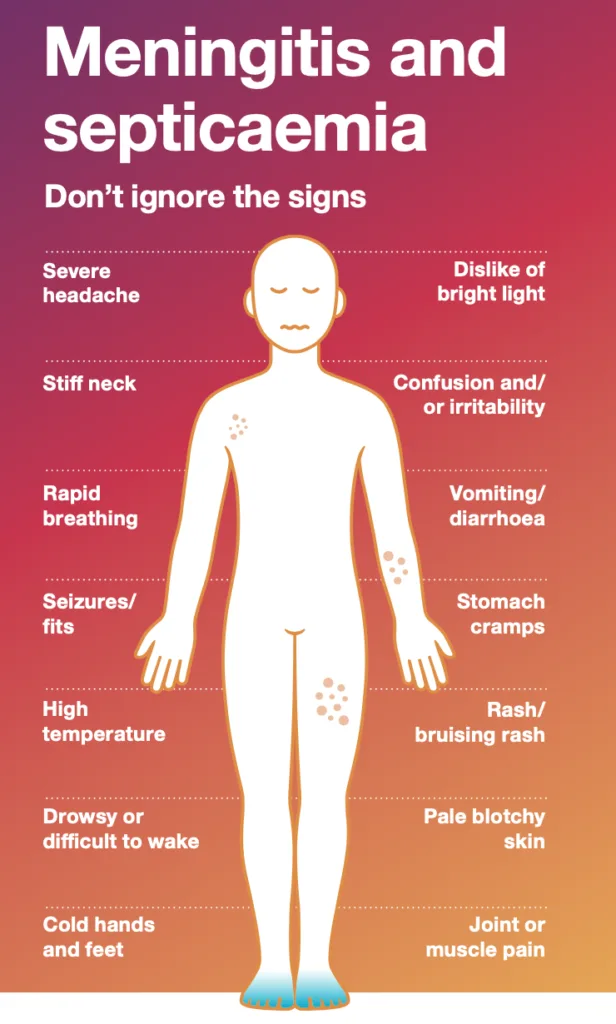
Initially meningococcal disease can be like a bad case of flu. But anyone affected will usually become seriously ill within a few hours. Early treatment can save your life so it is sensible to be aware of some main signs and symptoms.
One or more of these symptoms may develop and they can appear in any order and be mixed between the two illnesses. It is important to seek early medical advice if you or a friend have symptoms of concern or a condition that is getting rapidly worse. Don’t wait for a rash to appear – get medical help quickly.
Meningitis and septicaemia are very serious and require urgent attention. If you think you’ve got either, get medical help immediately and make sure your fellow students know to look out for you and each other.
Frequently Asked Questions.
- young people in the school year 13 age group (born between 01/09/2007 and 31/08/2008)
- young people born on or after 21/07/2001 and starting as undergraduates at university for the first time in autumn 2026
- young people born on or after 21/07/2001 living in further education accommodation or halls of residence for the first time in autumn 2026
Bexsero is a vaccine that helps protect against most strains of Neisseria meningitidis group B (MenB) bacteria. It contains four different proteins chosen to provide as broad protection as possible. It has been given to millions of babies in the UK routine immunisation programme since 2015 and has led to a 75% reduction in MenB disease in vaccinated age groups.
It takes at least 2 weeks from your second dose of vaccine for your body to produce antibodies to give you a good level of protection. It is important that you try to get both doses in before the autumn, particularly if you are starting university.
You can read about the Bexsero vaccine here: https://www.medicines.org.uk/emc/product/ 5168/pil#gref
Students coming from overseas should try and start the MenB vaccine course before coming to the UK. If you are offered a MenB vaccine, you should let the healthcare professional know if you think you have had one before. They will recommend the right vaccine for you and the number of doses required.
The vaccine used in this programme will be Bexsero. Older children and young adults need two doses of the vaccine. Bexsero is normally given at least four weeks apart to provide protection. The vaccines are given by injection, usually in the upper arm.
It is common to get some swelling, redness or tenderness where you have the injection. You may also get a mild fever, nausea, headache or muscle aches but these symptoms should disappear after one or two days.
You can take over the counter pain medication such as paracetamol to manage these symptoms if needed. More serious side effects are rare.
Cases of meningococcal disease due to other groups of the bacteria are now rare in the UK, thanks to effective vaccination.
Teenagers in the UK are offered a vaccine against groups A, C, W and Y at school, but this vaccine does not protect you against MenB. If you think you have missed out on the MenACWY vaccine you can check and catch-up with your GP.
More ways we can support you.
Emergency Hormonal Contraception
NHS Winter Flu Vaccination

NHS Oral Contraceptive Pill Initiation & Reviews
Stop Smoking Service
NHS Child Flu Vaccination